

What Is The Difference Between Drawing Conclusions And Inferences


Exercise you lot detect it hard to explain the difference between making inferences and drawing conclusions? If non, y'all are not alone. At lunch yesterday, this was a large debate amongst literacy specialists and instructional coaches. Are they synonyms? Is there a slight difference? Exercise you utilise inferring to depict conclusions? Today, I'm going to explore these and hopefully provide you with clarification and a next step for teaching.
The Difference with Drawing Conclusions and Making Inferences
Inferences:
Making inferences is the process of figuring out missing information from information that IS included . Inferences can be made with pictures, with characters, with plot, with the setting, and fifty-fifty with vocabulary. To infer is a thinking process of reading betwixt the lines. Nosotros can use pictures and text clues to infer, and making inferences are more situational.
Conclusions:
Conclusions are the judgments or decisions reached based on information learned. It requires reasoning or deep thinking and observation skills . I retrieve of cartoon conclusions as solving a mystery. Drawing conclusions is deeper than an inference. In fact, making inferences helps us draw conclusions.
Take the title image with the little guy sitting in the suitcase. Where is he going? How tin you tell? Well, this is a really fun fashion to give a concrete example to kids. About of united states of america take a suitcase on manus, so fill up information technology with items you'd utilize at a beach. Pull 1 item out at a fourth dimension, and permit the kids make simple inferences near the activities you'll do on your holiday. Then, discuss the conclusions they tin make based on all of the evidence in the suitcase and based on your discussions.
Examples of Making Inferences
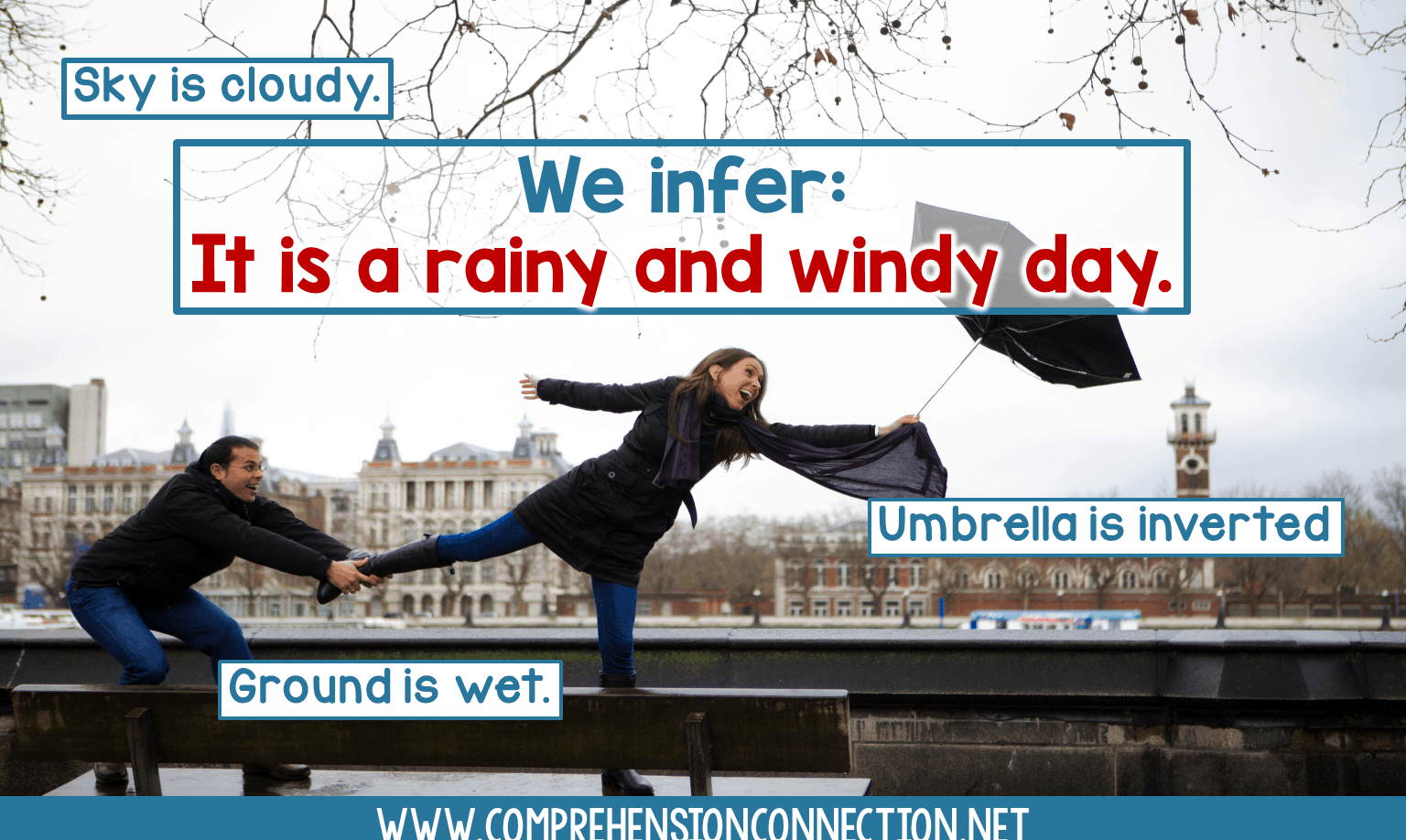
What we infer:
In this example, the facts we see are that the heaven is cloudy, the ground is moisture, and the umbrella is inverted. These facts betoken that information technology'south rainy because the ground's wet and because she has an umbrella. Nosotros can infer that information technology is windy based on the fact that the man is property on to the woman and considering the umbrella is inverted.
What nosotros conclude:
From this same photograph, you could also gather clues for a conclusion. You might wonder, "How will the atmospheric condition bear on the couples plans later in the day?" The couple has plans to get hiking. Well, we'd conclude that they'll cancel their plans considering it volition be dirty and impossible to hike without having their shoes stuck in the mud.

What we infer:
In this adjacent example, the facts we encounter are that the the boys are playing on a slip and slide. They are wearing bathing suits, and h2o is flowing over the plastic sail. These facts indicate that it must be warm and sunny considering I see a glow over the boys, and they're covered in water. I also infer that they are having fun since they are smiling and look happy. Finally, I infer that this cools them off since the h2o splashes up on them.
What we conclude:
Conclusions from this photograph is that many children like to play on slip and slides in the summer because they cool you off, are fun, and piece of work well with a grouping of kids. If it started to rain, nosotros'd probably conclude that the boys would get inside. Why? Well, at that place might exist a storm. It might besides go slippery running on the grass. Some other conclusion if rain moved in might be that the boys would prefer playing an indoor game. Why? Well, without the sun, it would get libation and wouldn't feel comfortable being wet in a bathing suit.
Concluding Thoughts on Drawing Conclusions and Making Inferences
So, the divergence betwixt an inference and a decision is in the depth. Conclusions crave a deeper agreement than an inference and clues that are gathered across the text or over time.
Equally you teach these skills, pairing them might clarify the deviation for your students. I'd recommend working with mentor texts to model the divergence. Here is a collection you might start with. Be sure to search on Pinterest for additional materials to go with these titles. Other bloggers have written about them.


Equally you practice, yous tin can refer to the anchor chart to the right and use it with these texts, I've besides included organizers that you tin can use for recording the facts, knowledge, inferences and conclusions. You might even use the same book for each purpose but to detect examples of each. This skill will take lots of practice equally information technology'southward probably the toughest for many kids to master since fourth and fifth graders are still at the physical thinking stage.
To access the anchor charts and lesson materials I'm sharing, delight sign upward for my email list using the grade beneath. Teaching the divergence betwixt an inference and a conclusion is really tough. I promise these suggestions volition aid break it downwardly for your kids.
Resources You Might Like:
Need a fun station action for additional practise? These paper purse mini books are lots of fun. They can be started in your small groups and sent to stations for finishing.
Making Inferences Newspaper Purse Book
Cartoon Conclusions Paper Bag Book

I hope you'll have a fantastic weekend and will come back soon. Don't forget to download the freebie above!


Source: https://www.comprehensionconnection.net/2019/03/exploring-difference-between-making.html
Posted by: higdonlifid2001.blogspot.com
0 Response to "What Is The Difference Between Drawing Conclusions And Inferences"
Post a Comment