

How To Practice Figure Drawing Without A Model
This is a huge guide to cartoon the human caput in the correct proportions…not simply is this a guide to depict the ideal woman and man's figure in correct proportions and measurements, but you lot will likewise learn how to draw the human being confront in the proper ratio & measurements from the side/profile view, frontal view, too every bit the iii quarters view. You volition likewise learn about how to exaggerate facial features to make drawings of people that deviate from the normal measurement, likewise as how to depict caricatures and drawing-like faces.
Guide to Drawing Proportional Man Figures Without Using Models




IF Y'all Demand TO COPY TEXT OF THIS ARTICLE…THE DIALOGUE OF THE Drawing TUTORIAL IS BELOW
PROPORTIONS OF THE HUMAN FIGURE AND DRAWING WITHOUT MODELS
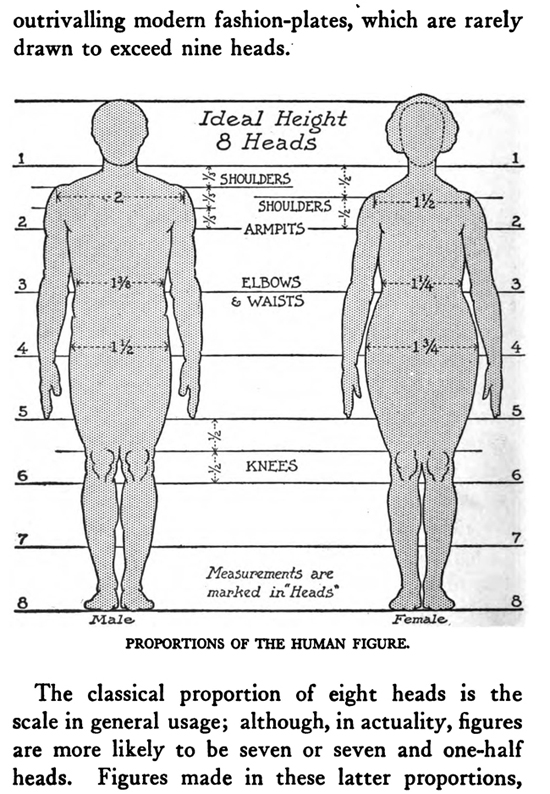
For practical piece of work from models, or drawing the figure without their apply, the creative person keeps in heed some sort of proportional division of the figure for guidance in getting an agreement in his drawing. The proportional quantities of the artistic calibration of the homo figure are given in "heads," established by taking the height of the head every bit a unit and seeing how many times it goes into the whole height of the figure. Opinions have differed as to the number of heads to reckon for the perfectly constructed figure. Vitruvius has given the scale of eight heads; while Vasari and Filarete both said that a harmonious accord of the human course is attained by edifice information technology on a scale of nine heads.
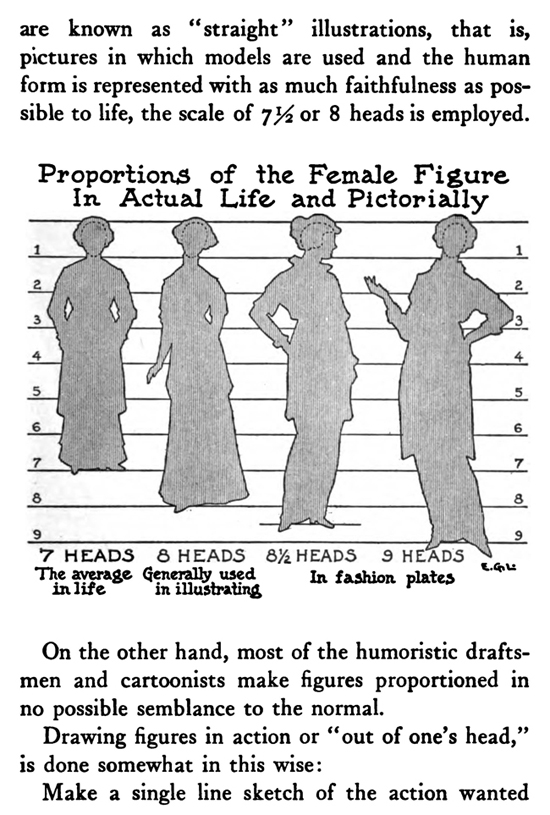
Some old engravings by Aldegrever bear witness figures that are drawn nearly ten heads high, actually outrivalling modern fashion-plates, which are rarely drawn to exceed 9 heads. The classical proportion of 8 heads is the calibration in general usage; although, in actuality, figures are more than likely to be vii or seven and half heads. Figures made in these latter proportions, in ordinary picturing, expect correct; only in idealistic compositions and in drawings in which nobility, grandeur, or the heroic are to exist expressed, the classical catechism of eight heads is improve.
Very careful measurements for an ideal homo form take been worked out—widths such as those of the calf, the knee, thigh, neck, so on; but equally a rule it is not necessary for cartoon that the artist should brunt his memory with such details. To practice so is more likely to lead to defoliation than to aid. Trying to remember and to work by the minor measurements may prevent the practise of good judgment and the aesthetic sense. Even if what are thought to be accurate measurements could exist taken, the words "estimate" and "about" would ever have to be tagged on anyway. For the lack of hard fixed points and the flabby nature of the muscle and peel make it impossible to get undecayed points from which to mensurate.
It is merely essential to remember a few full general ideas of symmetry, such equally: When the arm is hanging past the side the elbow is on a level with the waist, and the tips of the fingers achieve to about the center of the thigh. The vertical measurements for the female figure are commonly calculated as above; the proportions beyond varying—mostly smaller, excepting the hips. Such modest matters as relative thickness of neck and sizes of hands or feet depend on the subject, type, or graphic symbol to exist depicted.
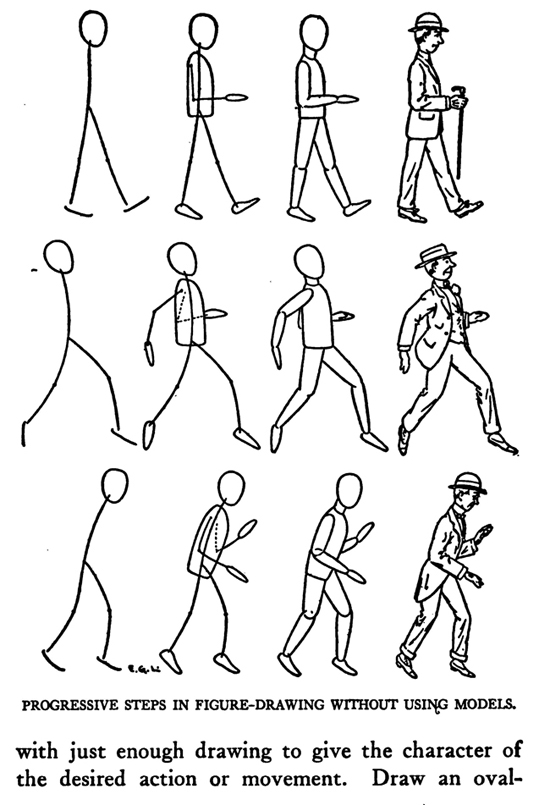
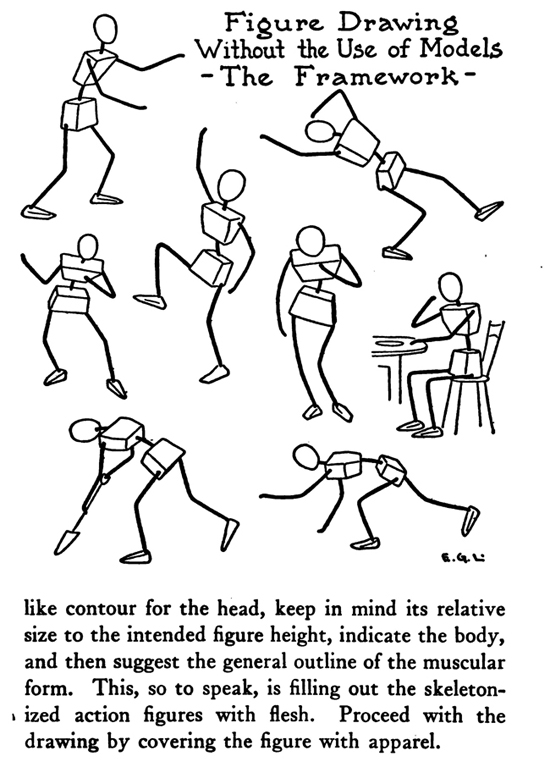
Some sort of a relative proportion of head to entire effigy should be kept in view when the creative person is drawing without models. When making what tiptop are equal. In an ideal effigy the bridge of the extended arms and the artistic judgment. On the other hand, most of the humoristic draftsmen and cartoonists make figures proportioned in no possible semblance to the normal. Drawing figures in activeness or "out of one'due south caput," is done somewhat in this wise:
PROGRESSIVE STEPS IN FIGURE-Drawing WITHOUT Use oF MODELS.
With just enough cartoon to give the character of the desired action or movement. Describe an oval-like contour for the head, continue in heed its relative size to the intended effigy tiptop, indicate the body, and so suggest the general outline of the muscular course. This, and then to speak, is filling out the skeletonized activity figures with flesh. Keep with the drawing by covering the effigy with wearing apparel.
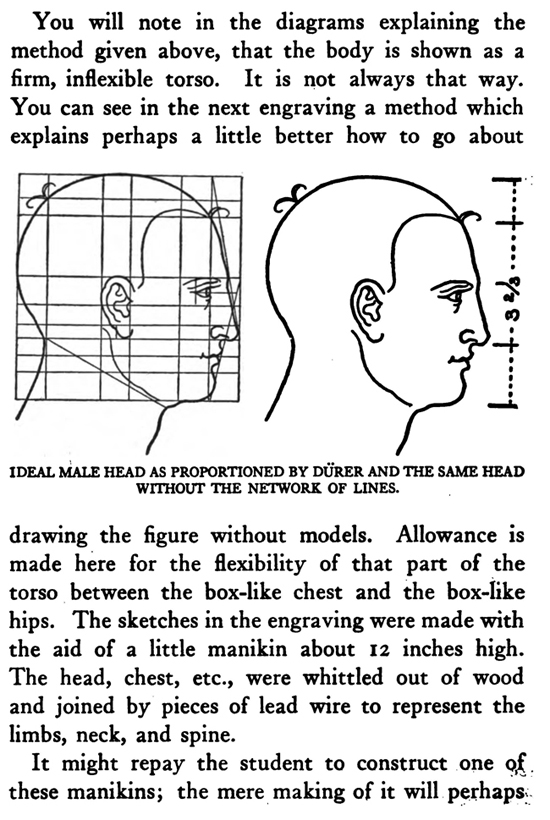
Platonic Male HEAD AS PROPORTIONED BY DIIRER AND THE Aforementioned HEAD WITHOUT THE NETWORK OF LINES.
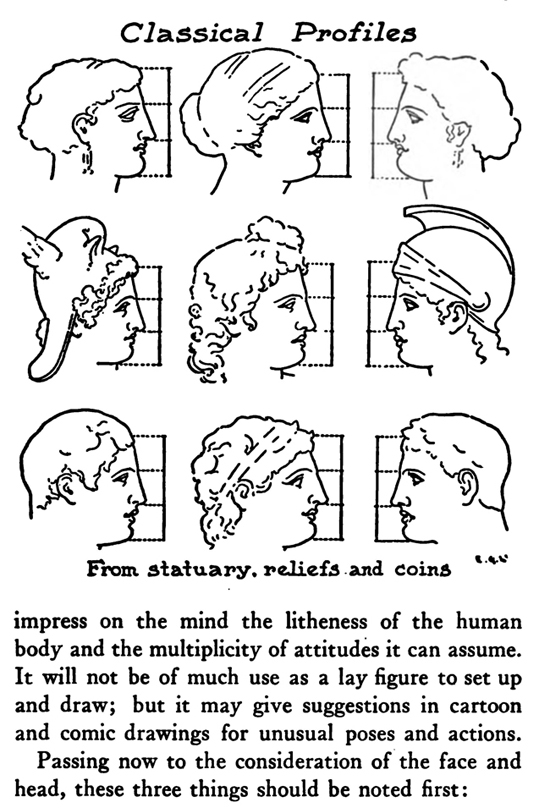
You volition note in the diagrams explaining the method given above, that the trunk is shown equally a house, inflexible torso. It is non always that way. You can come across in the adjacent engraving a method which explains perhaps a little better how to get about drawing the figure without models. Assart is fabricated here for the flexibility of that function of the torso between the box-similar chest and the box-like hips. The sketches in the engraving were made with the aid of a piffling manikin almost n inches high. The head, chest, etc., were whittled out of woods and joined past pieces of atomic number 82 wire to represent the limbs, neck, and spine. Information technology might repay the student to construct one og these manikins; the mere making of it will perhaps, reliefs and coins print on the mind the litheness of the human body and the multiplicity of attitudes information technology can presume. It volition non be of much use as a lay figure to set upwardly and draw; but it may give suggestions in cartoon and comic drawings for unusual poses and actions.
Passing now to the consideration of the face up and head, these three things should be noted start:
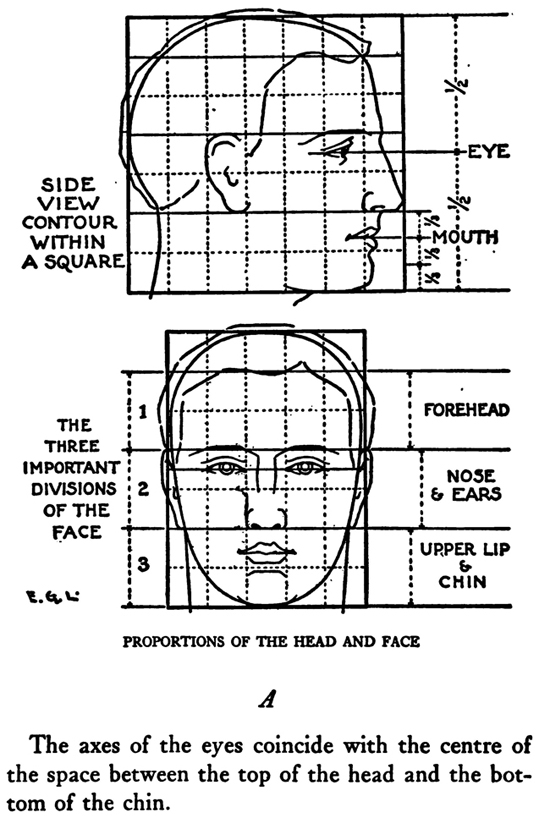
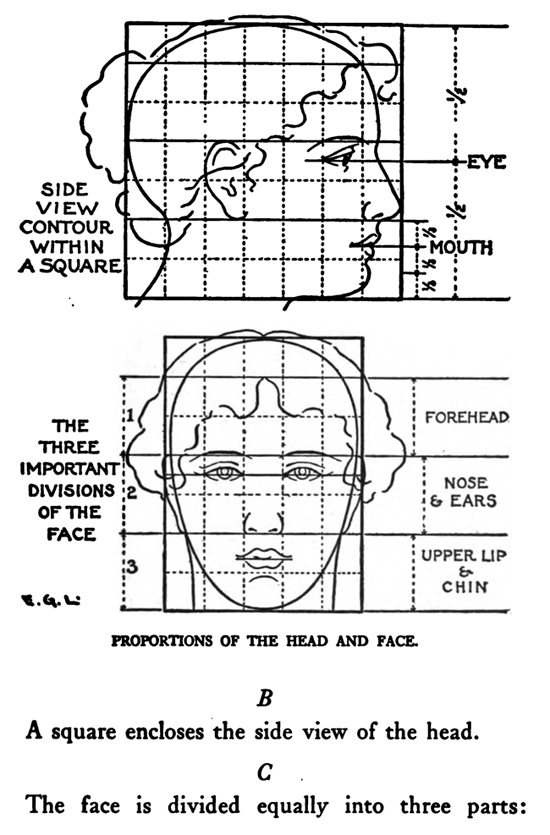
PROPORTIONS OF THE HEAD AND FACE
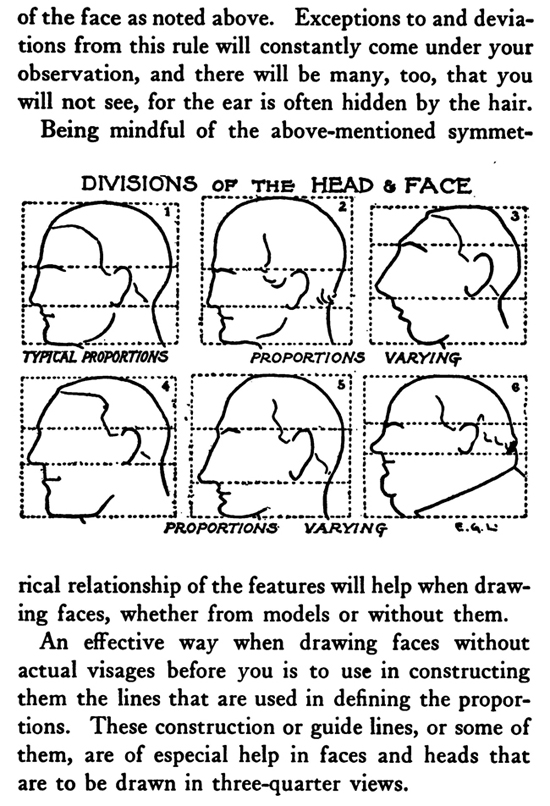
The axes of the eyes coincide with the centre of the infinite between the top of the head and the bottom of the chin. A square encloses the side view of the head.
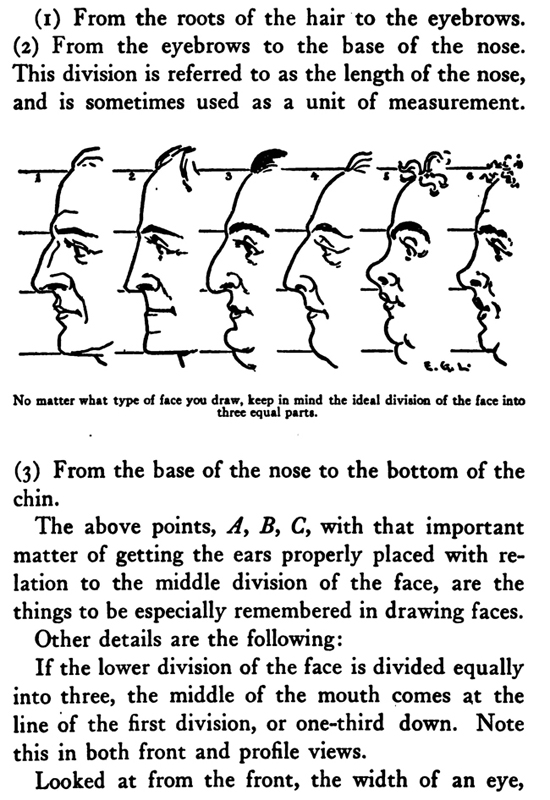
The face is divided equally into three parts:
(I) From the roots of the pilus to the eyebrows.
(ii) From the eyebrows to the base of operations of the nose. This division is referred to as the length of the olfactory organ, and is sometimes used as a unit.No matter what type of confront y'all draw, keep in heed the ideal division of the confront into 3 equal parts.
(3) From the base of operations of the nose to the bottom of the mentum.
The above points, A, B, C, with that of import matter of getting the ears properly placed with relation to the middle division of the face, are the things to be especially remembered in drawing faces.
Other details are the following:
If the lower division of the face is divided equally into 3, the middle of the mouth comes at the line of the first sectionalisation, or one-third down. Note this in both front and profile views.
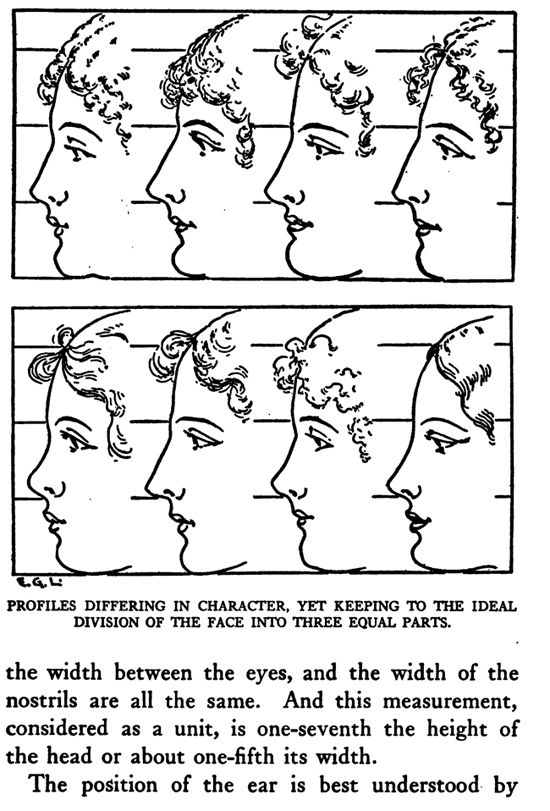
PROFILES DIFFERING IN CHARACTER, YET KEEPING TO THE Platonic Division OF THE Face up INTO THREE EQUAL PARTS.
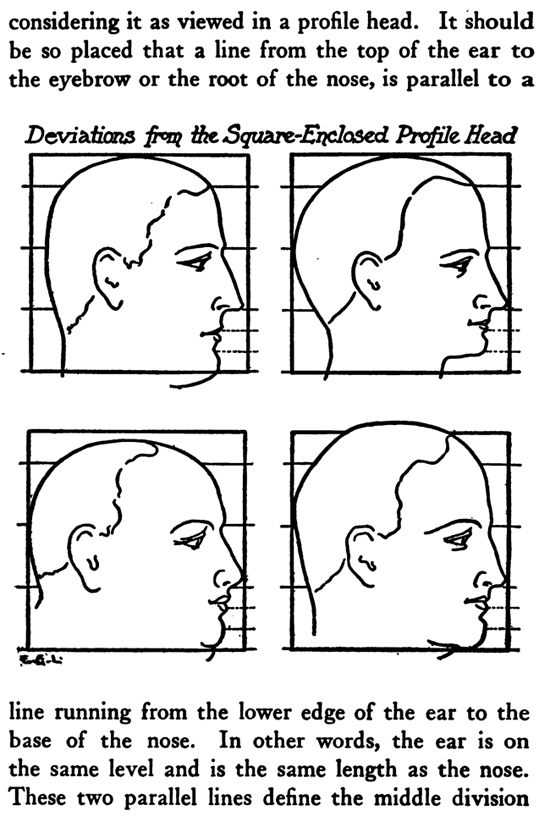
Looked at from the front, the width of an centre, the width betwixt the eyes, and the width of the nostrils are notwithstanding. And this measurement, considered as a unit, is one-seventh the height of the caput or about one-fifth its width. The position of the ear is best understood past considering it equally viewed in a profile caput. It should be so placed that a line from the height of the ear to the countenance or the root of the nose, is parallel to a Deviations from line running from the lower edge of the ear to the base of the olfactory organ. In other words, the ear is on the same level and is the aforementioned length as the nose. These ii parallel lines define the middle sectionalisation of the confront as noted to a higher place. Exceptions to and deviations from this dominion will constantly come up under your ascertainment, and there volition be many, too, that you volition non meet, for the ear is often subconscious by the pilus.
Beingness mindful of the higher up-mentioned symmetrical relationship of the features will help when drawing faces, whether from models or without them.
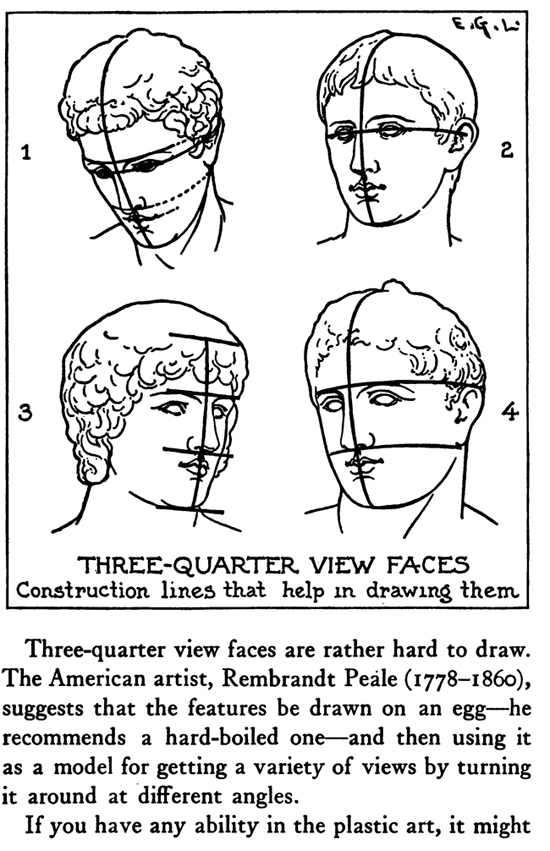
An effective style when drawing faces without bodily visages before you is to utilize in constructing them the lines that are used in defining the proportions. These construction or guide lines, or some of them, are of especial help in faces and heads that are to be fatigued in three-quarter views.
Iii-quarter view faces are rather hard to depict. The American creative person, Rembrandt Peale (1778-186o), suggests that the features be drawn on an egg—he recommends a hard-boiled one—and then using it as a model for getting a variety of views by turning it effectually at unlike angles.
If you take any ability in the plastic art, information technology might be a good program to model a little head for employ as a re-create. Such a head would be a great aid if you were making a series of illustrations (not using models) in which the aforementioned character appeared throughout the series.
Technorati Tags: figure drawing, drawing figures, proportional figures, human proportions, human measurements, draw people in measurements, depict faces, cartoon faces, how to draw proportional faces, measurements of man faces, how to draw, drawing lessons, drawing tutorials


Source: https://www.drawinghowtodraw.com/stepbystepdrawinglessons/2010/08/guide-to-drawing-proportional-human-figures-without-using-models/
Posted by: higdonlifid2001.blogspot.com
0 Response to "How To Practice Figure Drawing Without A Model"
Post a Comment